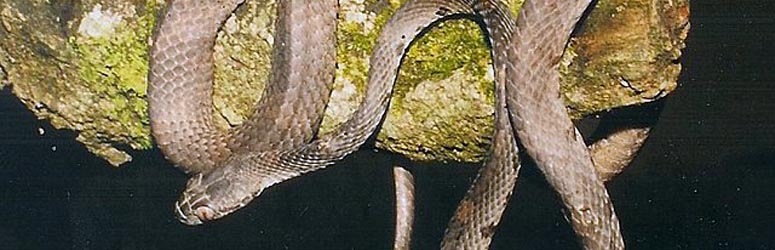
Distributed range & status
Endemic snake to Sri Lanka found in low & mid country wet zone 600m areas of south western hills & plains. Kandy, Gannoruwa, Nawalapitiya, Ginigathena, Matale, Gampola, Peradeniya, Hantana, Talgasmankada, Balangoda, Sinharaja, Nuchals, Gilimale, Matugama, Labugama, Kukulegala, Ambagamuwa.
Scales
rostral |
|
frontal |
1 |
supraoculars |
|
parietals |
|
prefrontals |
|
nasals |
Divided scale |
internasals |
2 |
loreals |
1 (longer than the width) |
preoculars |
2-3 (run along top of the head) |
postoculars |
2 |
temporals |
(2-6)+(3-6) |
Supralabials |
8 (4 & 5 connect to eye) |
mental |
|
infralabials |
|
sublinguals |
|
coastals |
Keels are present |
ventrals |
208-271 |
anal |
1 scale undivided |
subcaudals |
98-120 divided |
19 mid body scale rows are present. Vertebrals are large & hexagonal.
Characteristics
Middle sized, narrow & long laterally flattened body is present. Rounded snout & clear neck region is present. Head gets narrow towards the end. Large eyes have vertical pupil. Long prehensile tail is present.
Colour
The colour may vary. Dorsal body is orange, light brown, purple mixed brown, light grey or dark grey in colour with purplish-brown vertebral series of blotches running from nape to the mid tail region. Head is dark purplish-black with light grey postocular stripe. Light colour supralabials. Strip begins from the back of the eye & runs down to neck region. Ventral body contains cream with grey or brown spots.
Venom
These snakes are mildly venomous. Ophisthoglyphous fangs are present.
Dentition
Data not found.
Behavior
It is known as a nocturnal, arboreal snake. At the day time it’s not active & stay in a ball on small bushes or tree hollows. Do not try to attack. Not aggressive. When threatened they are known to shake their tails & try to bite. These snakes are mostly found living mostly in forests.
Breeding
They are oviparous snakes. They lay 2-4 eggs at a time in January.
Growth
At birth 150-200mm & grow up to 350-600mm.
Food
Lizards & skinks comprise the diet.
|